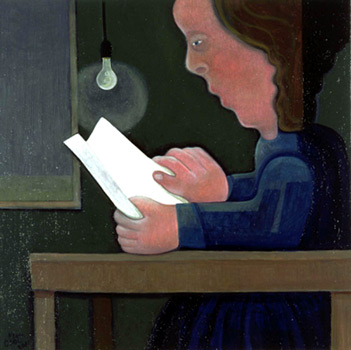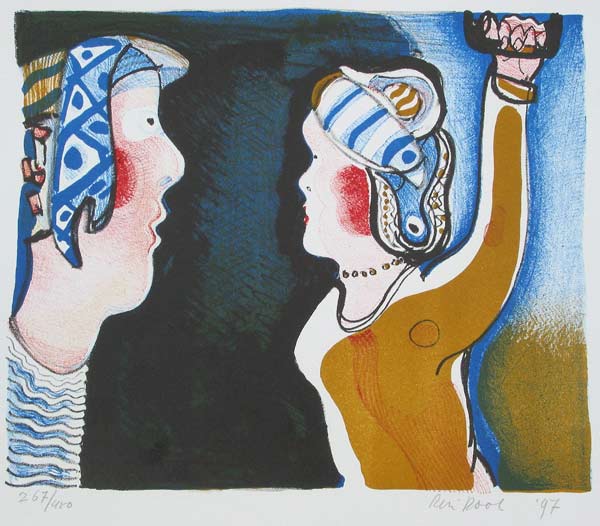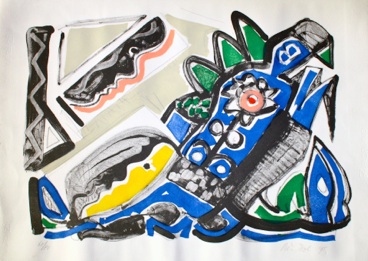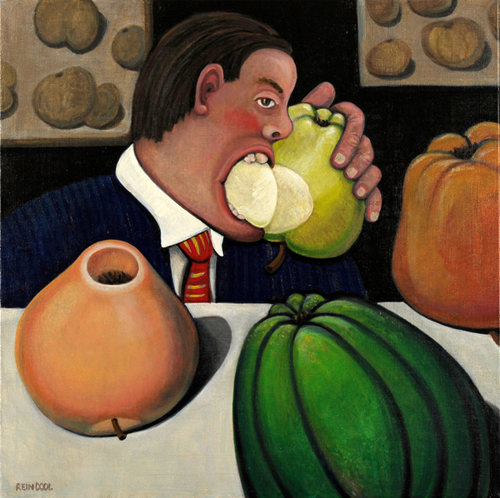
Rein Dool’s paintings were presented in Dutch Painters 1950 – 2000, the exhibition which opened the Danubiana Meulensteen Art Museum. The artist is one of the key figures of Dutch post-war painting. Dool’s oeuvre embraces a wide range of media, particularly sculpture, drawing, watercolour and prints. An artist of great creative potential and exceptional talent, he did not aspire to receive academic training, but established himself on the art scene as an autodidact.
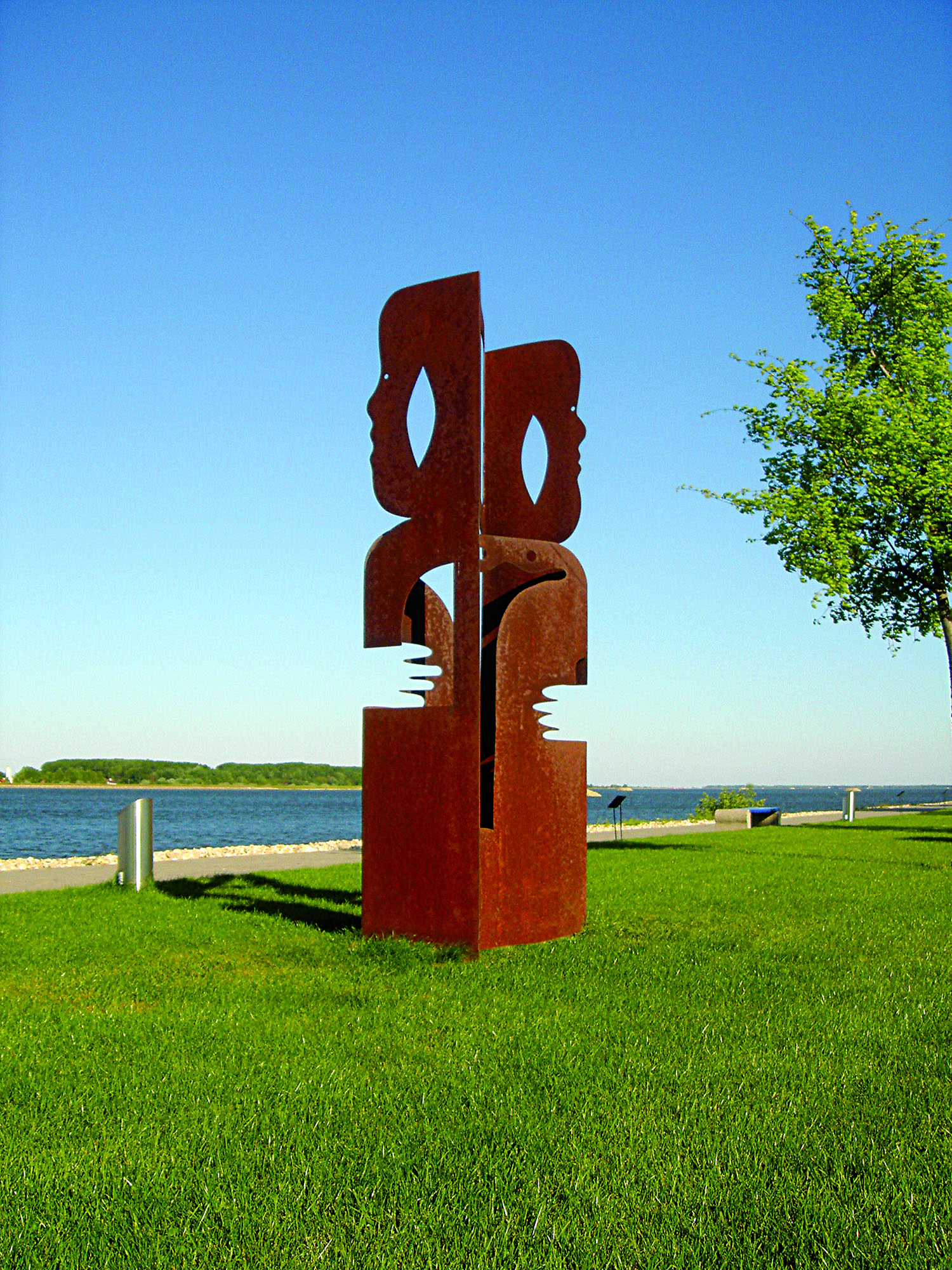
His boulder-like figures with swollen shapes are defined by an expressive contour line. Their distinctive naïve-like form can be loosely associated with the realism displayed in Botero’s works. Dool created his first sculptures in the early 1950s. Initially he was concerned with ceramics which he produced in Den Bosch, the European Centre of Ceramics. While working with clay, he made attempts at modelling and experimented with colour. His objects with compact block-like forms were painted in linear style, which appears in his paintings and water colours. In some of his paintings he applies, besides these figures, the planar geometric linear style showing the typical pictograms of his work: faces and profiles. Together with ceramics, the artist’s sculptural production consists of two groups defined by form and material. The bronze sculptures manifest his skill as a modeller who models and understands material in block-like form. Another part of his sculptural output consists of outdoor sculptures made of steel sheets of monumental dimensions. In these works he approaches the relation between sculpture and space in a different way. The motif is cut out from steel sheets on the principle of contrast between the positive and negative form. The sculpture becomes a perforated object opening up and penetrating into space. The prevalent motifs include profiles of faces or figures, which are merely contours of a play of shadows of forms. The outdoor sculpture Faces composed of three steel sheets expands into space, forming the shape of the letter “Z”. The profile of the female and male faces is endowed with the rhythm of full and empty surfaces. The view through the object into the landscape reinforces the experience of an otherwise austere sculpture.