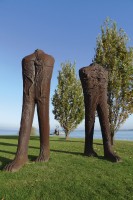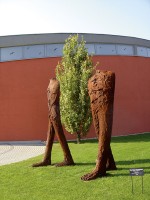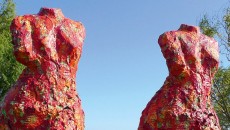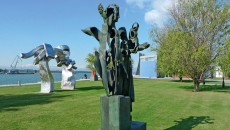
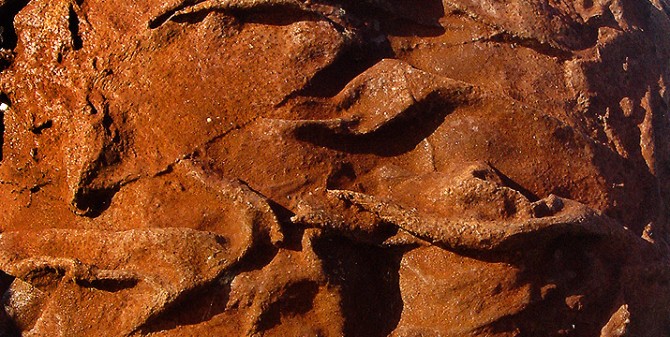
The distinguished Polish sculptor M. Abakanowicz achieved international recognition for her large threedimensional textile objects – abakans – in the 1960s. In the following decades she began to create sculptures from sackcloth cured with synthetic resin. These works were conceived as outdoor rather than indoor spatial compositions – installations based on the replication of a single figurative module – the idea of the crowd assaulting an individual. The human figure is often created as a hollow torso devoid of content, its wrinkled surface bearing traces of suffering. The configuration of dozens of torsos in different postures – standing, walking and crouching – creates areas charged with various emotional qualities: resolution, persistence, humiliation, bondage and lack of freedom. The economy of language exploits impressive dramatic expression and the legacy of humanism. The artist has created ’emotional’ areas from sculpture groups in many countries all over the world, including Israel, Japan, Germany, Italy and the United States. The series of Walking Figures was created in 1989 – 1999 for Vilnius, followed by The Crowd containing 95 figures. Paradoxically, she made her first outdoor sculpture group Unidentified, consisting of around 100 figures from reinforced concrete, for Poznan, Poland, only in 2002. The sculpture group Brothers, her distinctive walking torsos, puts this work in context with more than 100 sculptures made for Grant Park in Chicago. The installation at the Danubiana is part of this concept.